Discovery Issue 1
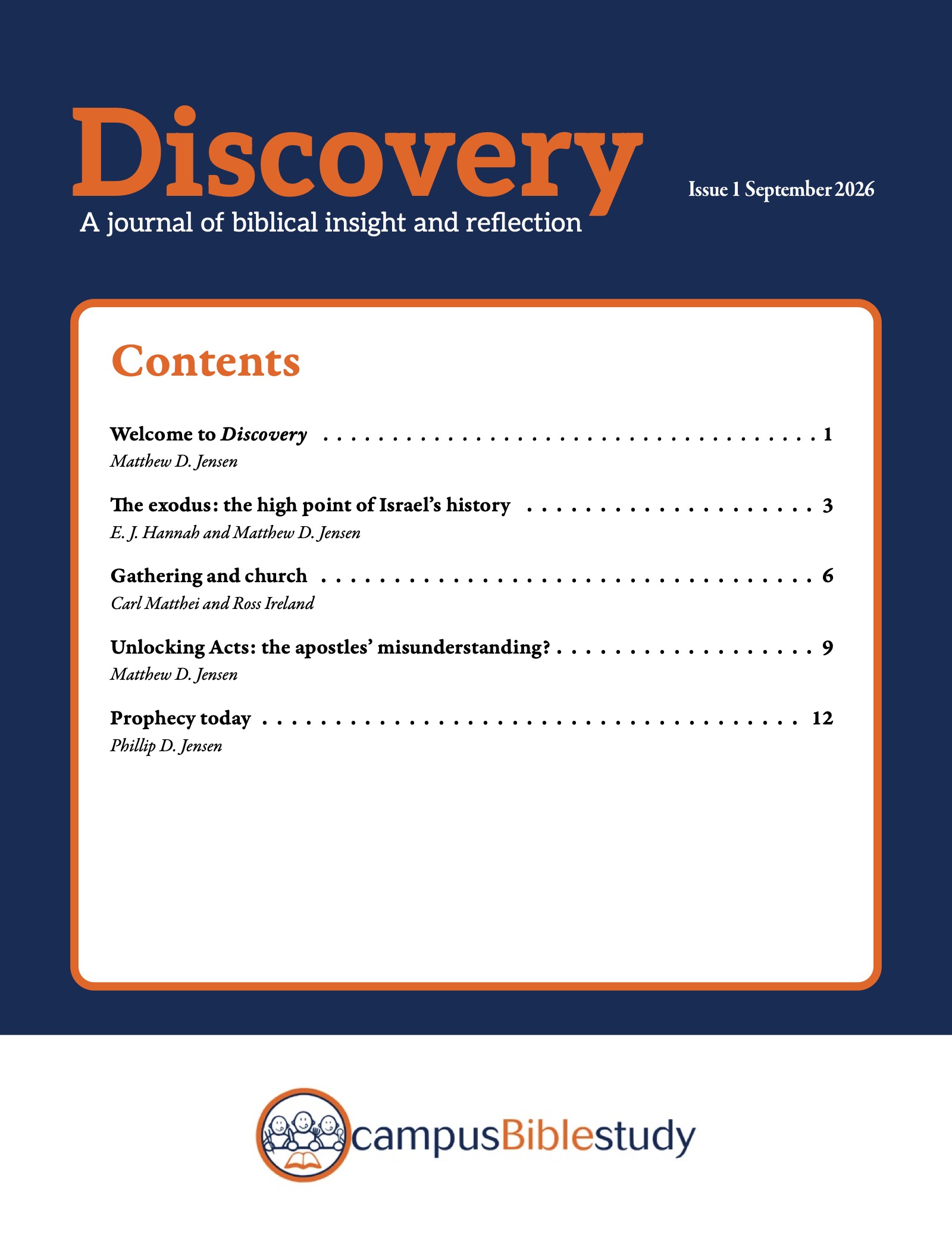
Please join the CBS Reading Club to access the journal.
Subscribers can find a copy here or go to your Downloads section.
Editorial: Welcome to Discovery
Matthew D. Jensen
Welcome to the first edition of Discovery. If you are looking for a venue where real biblical scholarship meets the everyday life of the church, you are in the right place. Discovery sits in a deliberately unique space: it is more than a casual magazine, but it is far less formal than a heavy academic journal. Published twice a year, it is written directly for thoughtful Bible readers, theological students, and anyone who wants to dig into God's word with fresh eyes.
Our goal is simple: to foster considered reading of the Bible. We do this by publishing short, punchy articles (around 1,500 words) that take cutting-edge ideas and translate them into clear, simple language. Every article opens with an explicit thesis statement, a series of biblical references to read before the article, and a step-by-step presentation of the biblical evidence.
The authors—all of whom hold to the AFES doctrinal statement-are not trying to lay down the final word on these topics. They believe the theses they put forward, but their larger goal is to propose fresh (or forgotten) ideas for you to test against the Scriptures. Some of these proposals might spur new insights; others might get trimmed, modified or challenged in your own discussions. That is entirely the point! These essays are like flying a kite—we unroll the string, stretch it out, and then run. Sometimes the kite will go up and fly, other times it will start to fly and crash to earth, and still other times it will just never get off the ground. By putting these ideas out into the open, we hope to spur us all on to read our Bibles more carefully as we evaluate these ideas together. The views expressed in Discovery are not official CBS policy; they are prompts to help us read the Bible carefully and thoughtfully.
In this inaugural issue, we explore four engaging proposals that challenge common assumptions about how we understand the Old Testament, the church, the apostles in Acts, and prophecy.
The exodus: the high point of Israel's history
This essay argues that the real high point of Israel's history wasn't the glory days of King David and King Solomon, but rather the exodus—when God rescued Israel from slavery in Egypt. Ed Hannah and Matthew Jensen point out that holding up David and Solomon as the peak is unlikely when it is remembered that David was a murderer and adulterer, and Solomon was an idolater whose actions split the kingdom. The essay suggests that getting a human king was a downgrade—a concession because the Israelites rejected God as their true king.
By placing the exodus and the giving of the law at the peak of Israel's history, the rest of the Bible's story makes more sense. It explains why the later prophets constantly look forward to a 'new exodus' when talking about future salvation. After Moses and Joshua, Israel's history is mostly a downhill slide of failing to keep the law until they hit rock bottom in the exile.
Read an online version of The exodus: the high point of Israel's history
Gathering and church
When you hear the word 'church', what comes to mind! For most of us, it is a local building, a Sunday time slot, or a specific order of service. In this article, Carl Matthei and Ross Ireland argue that the heavenly gathering around the living God and his Christ, rather than our experiences of our Sunday services, should shape our thinking about church.
Tracing the theme of 'gathering' from the Old Testament through Acts and the Epistles, Carl and Ross show that the biblical word ekklēsia simply means a gathering. Ultimately, the main 'church' in the New Testament is the great heavenly gathering of believers around Christ. Because Christians are already permanently gathered to Jesus in heaven, our earthly gatherings aren't limited to a single building or a once-a-week meeting. They can take many flexible forms whenever believers gather around God's word in prayer.
Unlocking Acts: the apostles' misunderstanding?
This article argues that the apostles basically misunderstood Jesus' instructions in Acts 1:8 because they were focused on God fulfilling his promises to Israel. Consequently, they didn't realize they were supposed to preach to the Gentiles.
We usually read "the end of the earth" as a reference to global mission, but the apostles were expecting Israel to be restored. Because of this, Luke presents them as understanding the Greek word gē as a reference to 'the land, not to the whole earth. Therefore, they thought they only had to preach to the geographic edges of the promised land. This explains some of the strange behaviour in Acts-such as why the apostles stayed in Jerusalem after the death of Stephen, or why it took three visions from God just to get Peter to talk to a Gentile!
This essay explores the importance of recognizing this misunderstanding for our reading of Acts. Seeing this keeps the true tension of Acts alive and shows what the early church was struggling with the most: figuring out how Jewish and Gentile believers fit together in God's big plan.
Read an online version of Unlocking Acts: the apostles' misunderstanding?
Read an online version of Unlocking Acts: the apostles' misunderstanding?
Prophecy today
Rounding out this issue, our final essay considers what Christian prophecy is and how we should understand it today. Phillip Jensen addresses the confusion surrounding this gift across charismatic, liberal and conservative circles. He contends that Christian prophecy is defined by its divine authorship and Christocentric content—bearing testimony to Jesus—rather than by its delivery mode or emotional outcome.
He walks through biblical history to show that all Old Testament prophecy pointed toward and reached its fulfillment in Jesus. With the coming of Christ and the outpouring of the Holy Spirit at Pentecost, all believers are now empowered to testify to Jesus. Prophecy today is not about spontaneous fortune-telling or socio-political opinion; it is simply the faithful, Spirit-backed proclamation of the testimony of Jesus.
Over to you
We hope these four articles stimulate your thinking, spark lively conversations in your Bible study groups, and encourage you to dig deeper into the Scriptures. Read them, test them, discuss them—and discover what God’s word has to say to us today. If you have a question or comment, why not use the electronic version of the digital tear-off slip or send an email to readingclub@campusbiblestudy.org